
OnRobot

Electric Grippers for Industrial Robots? Why That’s no Longer a Contradiction.

Article by James Taylor, CCO, OnRobot

Industrial automation is moving past old labels. We’re seeing a clear shift toward application-first thinking, where electric grippers are chosen.

For many years, electric grippers have been closely associated with collaborative robots. Often, they are framed as a ‘cobot accessory,’ while traditional industrial robots are assumed to require a different class of end-of-arm tooling (EOAT) altogether.

But this distinction has started to crumble at the same rate that the lines between cobots and industrial robots are blurring.

It’s a significant development reflected in the latest ISO robot safety standards, which do away with the terms ‘collaborative robot’ and ‘cobot’ , and replace them with the term ‘collaborative applications.’

We see this manifested on factory floors, where people no longer ask ‘What is the best gripper for this type of robot?’ Instead, they start at the application level. And increasingly, they choose electric grippers because of the value electric grippers bring to the application, regardless of robot type. This is a positive trend because, as the ISO standards have recognized, the application is what matters most.

Why industrial robot users are turning to electric grippers

Historically, electric grippers were pigeonholed due to their limited payload. Early designs were built to handle smaller, lighter parts, which naturally aligned with lower-payload robots. That assumption no longer holds.

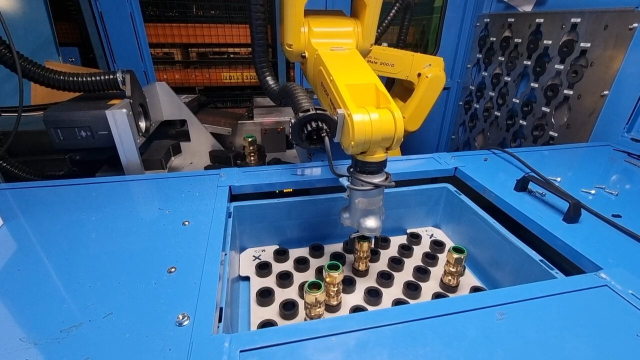
Today, electric grippers are available in significantly higher payload classes, including 25kg (55.11 lbs) models. On top of that, they can easily be deployed in dual-gripper setups, designed to meet the needs of demanding industrial applications like CNC machine tending and materials handling.

At the same time, users are discovering that electric gripper’s suitability is not just about payload capabilities. Built-in flexibility enables a single electric gripper to handle a wider range of part sizes without mechanical changeovers. For integrators and end users alike, this simplifies system design and reduces overall solution cost.

A big part of this is because electric grippers have a built-in intelligence that supports adaptability and software-driven performance tweaks. Electric grippers provide data feedback, position control, and other operation data that can be used to streamline your automation’s performance. Moreover, because of the data streams they provide, electric grippers are easier to incorporate into AI-based software and systems.
Peeling off outdated labels

The automation industry has been shaped by rigid categories. While these labels can be useful, they encourage a kind of tunnel vision when tooling decisions are made based on the robot type rather than on the application requirements such as payload, flexibility, footprint, energy consumption, and integration complexity.

Electric grippers challenge this thinking. Designed to be robot-agnostic, they do not inherently belong to one robot category or another. What matters most is whether they are suitable for the demands of the application. Increasingly, the answer is yes, including in traditional industrial settings with heightened demands around payload, power consumption, and stroke.

Electric opportunities

Energy efficiency is another major advantage of electric grippers. They consume power only when they move, unlike pneumatic systems, for example, which require a constant air supply. In an age where companies are increasingly attentive to energy use and sensitive about energy and environmental costs, electric gripper’s lower power consumption really matters.

Still, the many benefits of electric grippers remain underutilized in many industrial robot deployments. In part, this is due to the old robot categories that continue to channel peoples’ thinking around which type of gripper ‘goes’ with which type of robot. In part, it’s due to cultural inertia. Pneumatics are familiar, proven, and deeply embedded in legacy designs.

Voting with their feet

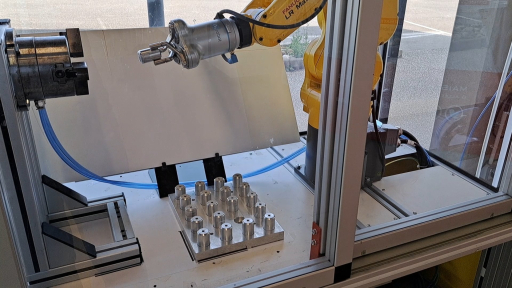
At OnRobot, we’re ideally positioned to see how things are evolving on the factory floor. In the past 6-12 months, there is clear evidence that industrial customers are re-evaluating electric grippers. Orders for electric grippers destined specifically for industrial robot cells are increasing, particularly in machining environments. Electric grippers are being chosen for their flexibility, compact footprint, built-in intelligence and low power consumption.

In application after application -from CNC machine tending to handling and packing products 20kg and above- electric gripper technology has matured.

Our customers are telling us that traditional perspectives no longer apply. It turns out that electric grippers can be used on industrial robots, in collaborative applications, and in industrial applications. They can handle demanding payloads. Their stroke rivals and even exceeds that of many traditional pneumatic grippers. And alongside all that, they provide data to your other systems -including AI-powered platforms- and they consume less power than the alternatives.

Integrators working primarily with industrial robots have noted that using a single, flexible electric gripper can simplify cell design and reduce the need for multiple tooling variants.

Electric Grippers and Traditional Industrial Robots? Why That’s no Longer an Oxymoron:

  • Electric grippers are increasingly being selected based on application needs, not robot type.

  • Modern electric grippers support higher payloads and demanding industrial tasks.

  • Built-in intelligence and data feedback in electric grippers enable flexibility, easier integration, and lower system complexity.

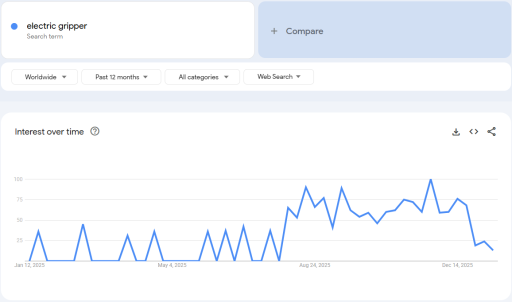
Image from Google Trends

An application-centered approach

Ultimately, the conversation around electric grippers in industrial applications reflects a broader shift in automation thinking. It’s not a complex shift, but it’s profound: instead of asking whether a component is best suited to cobots or industrial robots, people are asking whether the gripper is best suited to their application.

OnRobot’s electric grippers have been designed with this universality across all leading industrial robot types and brands in mind for many years. What’s changing now is not that aspect of the technology, but the willingness of the market to reassess old assumptions. For industrial robot users, this creates opportunities to improve performance, efficiency, and flexibility, using tools that are readily available

เลือกภาษา

Americas

English Español Português

Asia

繁体中文 한국어 简体中文 ภาษาไทย 日本語 Tiếng Việt

Europe

Čeština Dansk Deutsch English Español Français Italiano Magyar Nederlands Norsk Polski Português Română Suomi Svenska Türkçe
ภาษาไทย