For many years, electric grippers have been closely associated with collaborative robots. Often, they are framed as a ‘cobot accessory,’ while traditional industrial robots are assumed to require a different class of end-of-arm tooling (EOAT) altogether.
But this distinction has started to crumble at the same rate that the lines between cobots and industrial robots are blurring.
It’s a significant development reflected in the latest ISO robot safety standards, which do away with the terms ‘collaborative robot’ and ‘cobot’ , and replace them with the term ‘collaborative applications.’
We see this manifested on factory floors, where people no longer ask ‘What is the best gripper for this type of robot?’ Instead, they start at the application level. And increasingly, they choose electric grippers because of the value electric grippers bring to the application, regardless of robot type. This is a positive trend because, as the ISO standards have recognized, the application is what matters most.
Why industrial robot users are turning to electric grippers
Historically, electric grippers were pigeonholed due to their limited payload. Early designs were built to handle smaller, lighter parts, which naturally aligned with lower-payload robots. That assumption no longer holds.
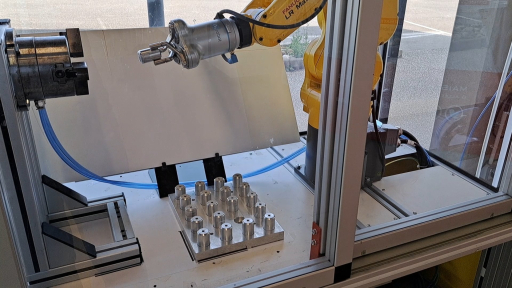
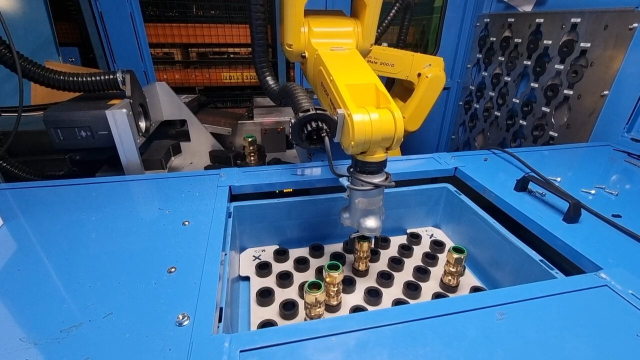
Today, electric grippers are available in significantly higher payload classes, including 25kg (55.11 lbs) models. On top of that, they can easily be deployed in dual-gripper setups, designed to meet the needs of demanding industrial applications like CNC machine tending and materials handling.
At the same time, users are discovering that electric gripper’s suitability is not just about payload capabilities. Built-in flexibility enables a single electric gripper to handle a wider range of part sizes without mechanical changeovers. For integrators and end users alike, this simplifies system design and reduces overall solution cost.
A big part of this is because electric grippers have a built-in intelligence that supports adaptability and software-driven performance tweaks. Electric grippers provide data feedback, position control, and other operation data that can be used to streamline your automation’s performance. Moreover, because of the data streams they provide, electric grippers are easier to incorporate into AI-based software and systems.