OnRobot

Reduce Finishing Time, Energy Use, and Variability with Sanding Automation

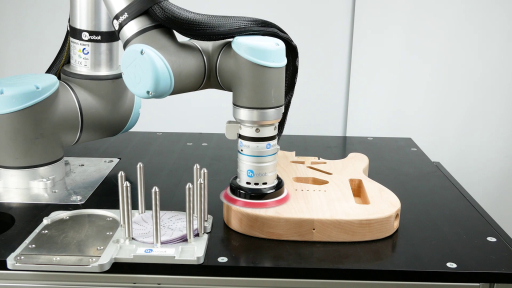
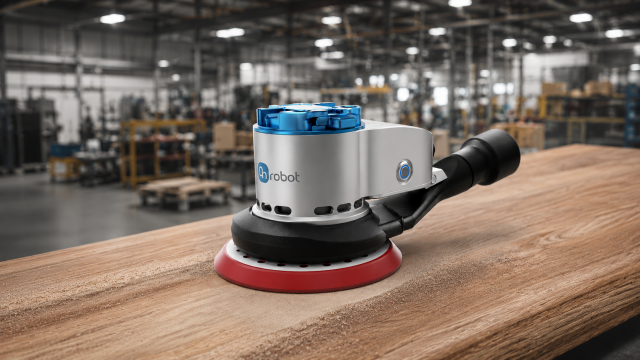
OnRobot Sander’s automated Grit Changer improves efficiency by providing automatic switching of sanding discs without the need for manual operator intervention. The Grit Changer is a simple, affordable accessory that is fully integrated into the OnRobot Sander software.

80%. That’s the massive reduction in sanding time EsVata Shutters enjoyed when they deployed robotic sanding on an intensive manual task, finishing wooden window shutters.

“If you talk to any woodworking person, I would say 90% or more would agree that sanding is one of the least fun things to do,” says Paul Hsieh, founder of EsVata Shutters. “Having a robot doing it is pretty amazing.”

At EsVata, workers used to operate orbital sanders, leading to inconsistent results. By deploying the OnRobot Sander, EsVata Shutters has seen not just time but also significant quality improvements:

”By reducing sanding time, we haven't sacrificed quality. Our quality has increased about 20-30%,” says Hsieh.

EsVata Shutter’s experience isn’t an outlier. Many companies have achieved similar results by automating sanding, buffing, and polishing applications. But these tasks create unique challenges, and not all sanding technology can handle end user requirements or expectations around usability.

Finishing is sensitive to geometry, contact conditions, and force. Inconsistent path control can quickly turn a simple sanding task into scrapped parts or rework.

Sanding is harder to automate than it looks

Sanding isn’t just about moving abrasive discs across a surface. Sanding depends on continuous adjustment to force, contact angle, and surface variation.

On complex flat, curved, or spherical surfaces, contact conditions change with every movement. Programmed joint trajectory alone cannot guarantee consistent contact. Without active force control, small part tolerances produce unpredictable results.

Human operators can sense when contact is too light or heavy and can adjust pressure and angle accordingly in real time. Translating that adaptability into automation requires tools that can sense and respond, not just follow a pre-defined path.

Many traditional sanding automation attempts stall because systems that lack force feedback or rely on rigid fixtures end up producing uneven finishes or require extensive manual rework.
Force control and repeatability for reliable finishing
Consistent surface quality depends on repeatable force application and torque control. In automated sanding, the following capabilities are key:

EsVata Shutters leaned on these capabilities in the OnRobot Sander, successfully replacing human variability with consistent force and path control, which in turn enabled predictable finish quality.

Simplify deployment with OnRobot Sander

A major barrier in sanding automation has been the complexity of tooling and system integration. Tools that require external force control systems, pneumatic infrastructure, or custom sensor arrays extend deployment times and increase costs.

The OnRobot Sander is engineered to address these challenges directly:

Additional features for rapid deployment include automatic path generation, based on hand-guiding, waypoints, or scanned part geometry. A big factor in EsVata choosing the OnRobot Sander was its adjustable rotational speed from 1,000–10,000 RPM. “The added feature of controlling the RPM is very precise,” says Hsieh. “Adding that onto the 3/16th orbital method for fine sanding, that plays a crucial factor in making sure products are evenly sanded.”

Integrating the OnRobot Sander to the robot arm happens through a fast, easy setup with a patented tool locking mechanism, letting operators attach or change tools in seconds.

Eliminate compressed air costs

Compressed air is a common utility in industrial tooling, but it is also one of the least efficient. According to the U.S. Department of Energy, compressed air systems in typical industrial facilities operate at efficiencies below 50% and can account for up to 30% of total electricity consumption. Leaks, pressure drops, and the need for dryers and regulators only make things worse.

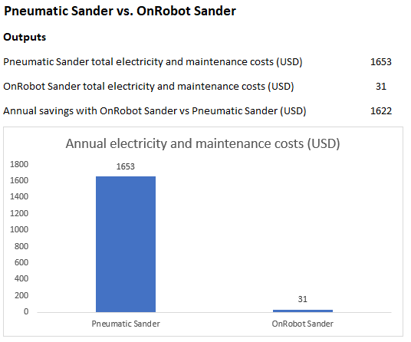
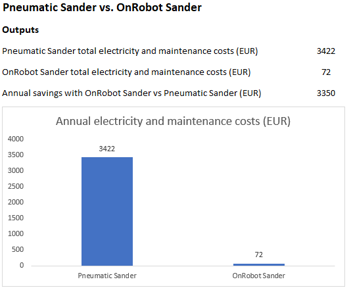
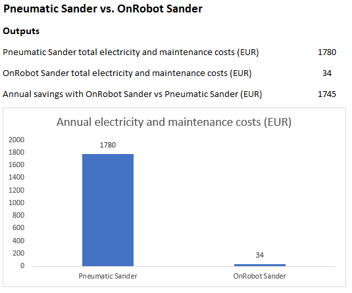
In this context, electric tools offer real advantages. Studies show that electric tools reduce operating costs by as much as 90% by removing the need for compressed air. In the U.S. for example, manufacturers can save more than $1,600 annually on electricity and maintenance in a single shift with 240 days of operation with the OnRobot Sander versus pneumatic alternatives, in countries where the cost of electricity is higher, such as Denmark, the cost savings amount to more than €3,300.

The elimination of compressed air removes not just energy costs but infrastructure complexity: there are no air lines, no pressure regulation, no dryers, no leaks to manage.

USA Example
USA Example
Denmark example
Denmark example
Singapore example
Singapore example

Productivity gains through automated grit handling

One of the unseen drags on sanding productivity is the need to switch abrasive discs during multi-stage finishing. Manual grit changes interrupt cycles, require supervision, and introduce variability in timing and technique.

OnRobot Sander’s automated Grit Changer improves efficiency by providing automatic switching of sanding discs without the need for manual operator intervention. The Grit Changer is a simple, affordable accessory that is fully integrated into the OnRobot Sander software.

In addition, OnRobot Sander provides a re-try feature that automatically handles unsuccessful picks and comes with grit stack and usage monitoring features that send out a warning before your stack runs out.

Turn finishing into a predictable, scalable process

The EsVata Shutters example illustrates what is possible when companies deploy grippers that combine ease of use with advanced capabilities. Controlled force, clear integration pathways, energy-efficient tooling, and automatic grit handling give your sanding application what it needs to run reliably.

With the right technology, sanding automation can deliver consistent quality, operational savings, and throughput gains, as EsVata Shutters discovered.

Ready to talk about how OnRobot Sander can help your operations? Contact us.

選擇語言

Americas

English Português Español

Asia

简体中文 繁体中文 日本語 한국어 ภาษาไทย Tiếng Việt

Europe

English Čeština Dansk Nederlands Suomi Français Deutsch Magyar Italiano Norsk Polski Português Română Español Svenska Türkçe
繁体中文